

Key Takeaways
Nutrition value per dollar
Nutrition value per dollar is a way of thinking about food that measures how much protein, fiber, vitamins, and minerals a food provides relative to what it costs. Foods that are inexpensive but dense in nutrients deliver more health benefit for each dollar spent. This framing helps families move past the assumption that healthy food is always costly.
Dietitians sometimes call this concept 'nutrient density,' which compares the amount of beneficial nutrients in a food to its calorie content; cost per nutrient unit adds the price dimension to that calculation.
Where the 'healthy food costs more' idea comes from
The belief that nutritious eating requires a large grocery budget is widespread, and it is not entirely baseless. Specialty health stores, premium organic labels, and trendy superfoods genuinely do cost more than staple items. Marketing amplifies this: products positioned as 'wellness' carry price premiums that have little to do with their actual nutritional content.
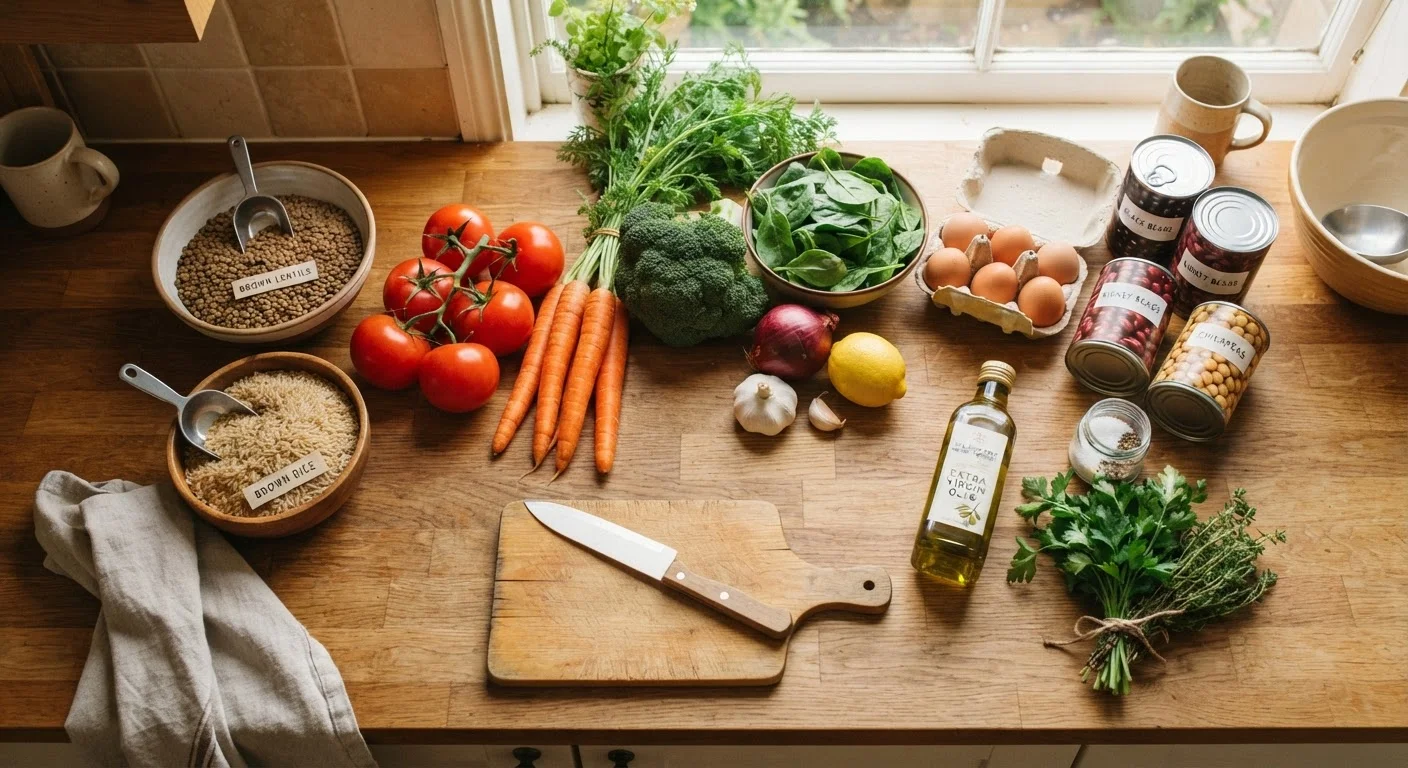
What gets lost is that the most nutritionally productive foods are rarely the most expensive ones on the shelf. Dried lentils, rolled oats, canned sardines, eggs, brown rice, and frozen spinach are not marketed as health foods, so they rarely appear in conversations about eating well. Yet each delivers a strong nutritional profile at a low per-serving cost. The wellness spending myths that push families toward expensive products often rest on gaps between marketing and evidence.
What affordable whole foods actually deliver
A useful way to evaluate food is to weigh the nutrients it provides against what it costs per serving. Several whole foods do well by this measure.
- Dried legumes (lentils, black beans, chickpeas) provide protein, iron, fiber, and folate. A one-pound bag of dried lentils makes roughly ten half-cup cooked servings and typically costs under two dollars.
- Eggs supply complete protein, B vitamins, and choline. Per gram of protein, eggs are among the least expensive sources in a US grocery store.
- Rolled oats provide soluble fiber, manganese, and moderate protein. A large canister lasts weeks of breakfasts at pennies per serving.
- Frozen vegetables (spinach, broccoli, peas) retain most vitamins through freezing and cost substantially less than fresh equivalents, especially out of season.
- Canned fish such as sardines and tuna offer protein and omega-3 fatty acids at a fraction of the price of fresh fish.
None of these require a specialty store. They are available at nearly every US grocery chain, discount grocer, and warehouse store.
$0.18
Approximate cost per serving of dried lentils
Based on typical US retail pricing for a one-pound bag of dried lentils yielding roughly ten half-cup cooked servings.
3x
Cost difference between home-cooked and restaurant meals
USDA Economic Research Service data consistently shows home-prepared food costs substantially less per meal than food away from home.
30-40%
Share of purchased food discarded by US households
USDA estimates suggest American families waste a significant portion of food bought, representing both financial and nutritional loss.
How cooking habits affect the nutrition-cost equation
What a family cooks matters as much as what it buys. Home-cooked meals from whole ingredients cost less per serving than restaurant meals, takeout, and most packaged convenience foods, and they typically contain less sodium and added sugar. A pot of lentil soup made at home costs a fraction of a prepared soup from a health-focused brand, yet the nutritional content can be comparable or better.
Meal planning has a direct effect on spending. Families that plan meals before shopping buy more of what they will actually use, which reduces food waste. The USDA estimates that American households discard a significant share of the food they purchase, meaning unplanned buying wastes both money and nutritional value. A simple weekly meal plan, even an informal one, closes that gap. For a practical look at how food budgets actually break down, see what the numbers actually look like.
Batch cooking, which means preparing larger quantities of grains, legumes, or roasted vegetables at one time, reduces the daily time cost that sometimes drives families toward processed convenience foods. Cooked beans and grains store well in the refrigerator for several days and can form the base of multiple meals.
Common substitutions that lower cost without lowering quality
Specific swaps often yield the largest savings with the least nutritional trade-off.
- Dried beans instead of canned: nutritionally identical once cooked, and typically 50 to 70 percent cheaper per serving. The time investment is soaking and a longer cook, or a pressure cooker shortens that significantly.
- Frozen berries instead of fresh out of season: comparable vitamin content, lower cost, and no spoilage risk.
- Whole chicken parts or thighs instead of boneless skinless breast: lower per-pound cost, comparable protein, and usable for both main dishes and stock.
- Store-brand canned tomatoes, beans, and fish: the ingredient list is generally the same as name-brand equivalents at a lower price point.
The evidence on affordable eating backs this up: cost and nutritional quality do not move in the same direction as reliably as many families assume. Understanding why grocery spending creeps up can help families redirect that money toward whole-food staples.
This article provides general nutrition information for educational purposes and is not a substitute for personalized advice from a registered dietitian or healthcare provider.