

Key Takeaways
Option A
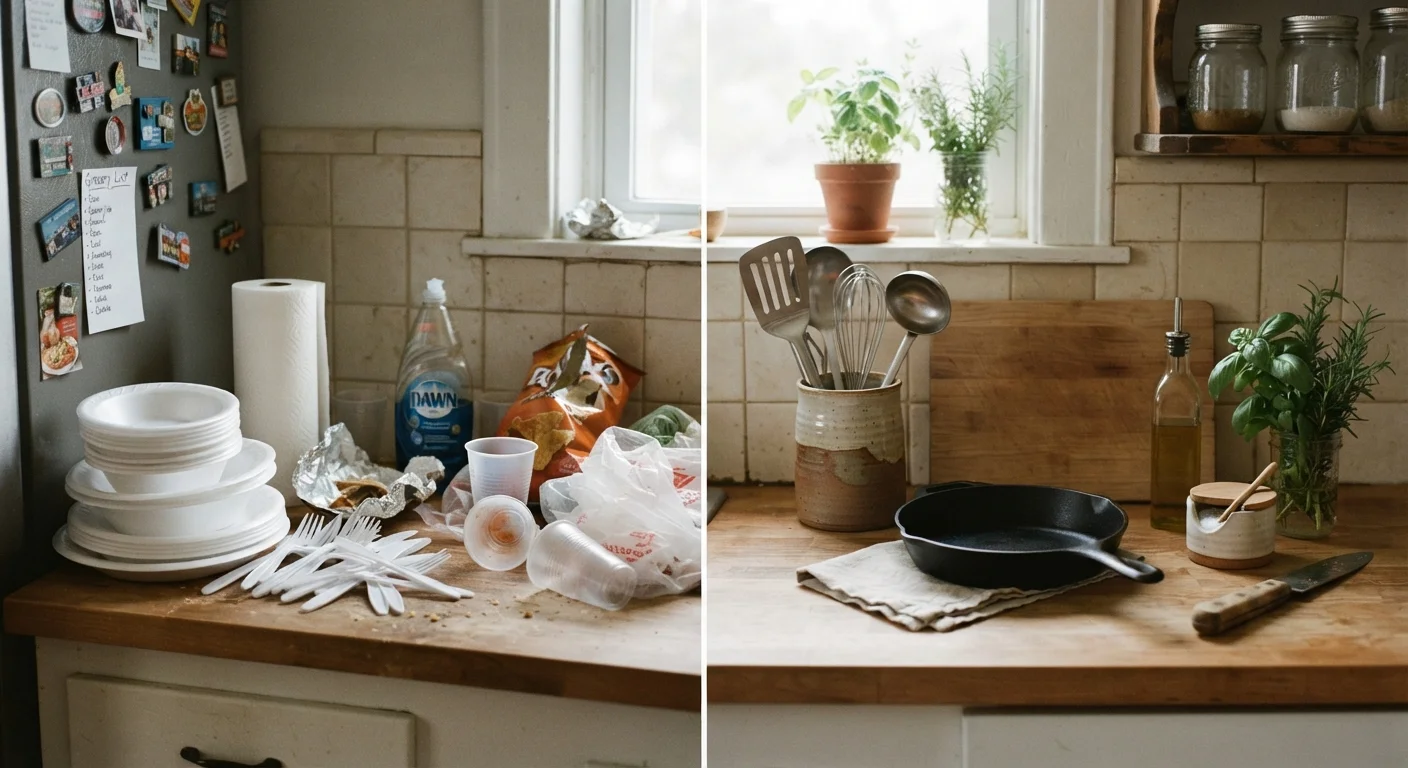
Buying less
The restraint-first approach to household spending.
Best for: Households that want to lower total spending by reducing how often they buy, regardless of price point.
Option B
Buying better
The quality-first approach to household spending.
Best for: Households willing to spend more upfront on fewer items that last longer and require less frequent replacement.
If your household budget is tight right now
Buying less
Reducing purchase frequency frees up cash immediately without requiring larger upfront outlays. It is the faster lever when margin is thin.
If you repeatedly replace the same items within a year or two
Buying better
Frequent replacement of cheap goods often costs more over time than one durable purchase. Check your spending history before defaulting to the lowest price.
If you are still figuring out what your household actually uses
Buying less
Accumulating fewer items first helps you identify what is genuinely needed before committing to any premium purchase.
If you have stable income and a clear long-term need
Buying better
Stable cash flow makes the upfront cost manageable, and a confirmed long-term need means a durable item will actually be used long enough to pay off.
If you want to apply one approach across the whole household
Buying less
Buying less is easier to apply broadly without category-by-category analysis, making it a practical default when bandwidth for decision-making is low.
What each approach actually means
Buying less is about reducing how much you purchase overall. It does not specify price or quality. The goal is fewer transactions, fewer items in circulation, and lower total spending. This approach works by pausing purchases that are habitual or convenience-driven rather than genuinely needed.
Buying better is about paying more per item to get longer use from fewer purchases. The logic is that a well-made item used for ten years costs less in total than three cheap versions bought over the same period. The tradeoff is higher upfront cost and the need to correctly predict which items will actually get long-term use.
These two approaches are not opposites. A family can buy less and still choose quality when they do buy. The tension shows up when budget pressure forces a choice: spend less now, or spend more now to spend less later. That calculation depends on the category, the household's cash position, and how reliably the item will be used.
See how intentional lifestyle choices differ from simple cost-cutting for context on why restraint alone does not capture the full picture.
Where each strategy performs well
Buying less works well in categories where items accumulate faster than they get used. Clothing, kitchen gadgets, decorative items, and hobby supplies are common examples. Households that audit what they already own before buying anything new often discover they have multiples of things they forgot about. The household declutter audit is a practical starting point for identifying where buying has outpaced use.
Buying better tends to pay off in categories with predictable, high-frequency use and clear quality differences. Cookware, mattresses, work footwear, and major appliances are categories where durability matters and the cost-per-use math often favors the pricier option. Cheap fixes in home repair follow the same pattern: a lower upfront cost can produce a larger total bill if the fix fails quickly.
The strategy breaks down when it is applied without category analysis. Spending more on items used rarely does not save money. And refusing to spend on a genuinely durable, high-use item because it costs more upfront can be its own form of false economy.
| Criterion | Buying less | Buying better |
|---|---|---|
| Primary mechanism | Reduce purchase frequency | Increase item durability |
| Upfront cost | Lower (or none) | Higher per item |
| Long-term cost | Varies by category | Lower if item is used fully |
| Cash flow requirement | Low | Moderate to high |
| Risk of misapplication | Under-buying necessities | Overpaying for rarely-used items |
| Easiest to apply in | Impulse or low-use categories | High-frequency, durable-goods categories |
| Requires category analysis | Less so | Yes, consistently |
The cash flow problem with buying better
The main practical barrier to buying better is that it requires cash in hand today for savings that arrive later. A family with $200 left at the end of the month cannot always absorb a $180 purchase, even if that purchase would prevent three $70 replacements over five years. The math works, but the timing does not.
This is why buying less is often the more accessible starting point. Cutting purchase frequency does not require a large payment; it requires stopping a purchase. For households managing irregular income or tight margins, that distinction matters. Zero-based budgeting can help identify where spending is happening and where pausing it frees up room for an intentional quality purchase later.
Spending patterns also play a role. Some habits drain budgets in ways that are easy to miss until they are tracked. Patterns that quietly undermine financial comfort often look like small, frequent purchases rather than large ones, which is exactly the territory where buying less has the most impact.
How to apply both in the same household
Most households do not need to choose one approach and abandon the other. A workable method is to default to buying less in low-use or uncertain categories, and to apply buying better selectively in high-use categories where you have a track record of actually using the item.
Before any purchase, two questions help: How often will this actually be used? Have I replaced something like this before, and how quickly? If use is uncertain, buying less (or waiting) is usually the lower-risk choice. If the item is a confirmed daily need with a history of replacement, the case for spending more upfront is stronger.
Food budgets follow a similar logic. Spending less on groceries does not always mean buying cheaper food. How family food budgets actually work shows where the real cost drivers are, and they are not always where families expect. The same principle applies to household goods: the category and use pattern matter more than a blanket rule about cheap versus quality.
This article is for general informational purposes only and does not constitute financial advice. Readers should consult a qualified financial professional for guidance specific to their own situation.