

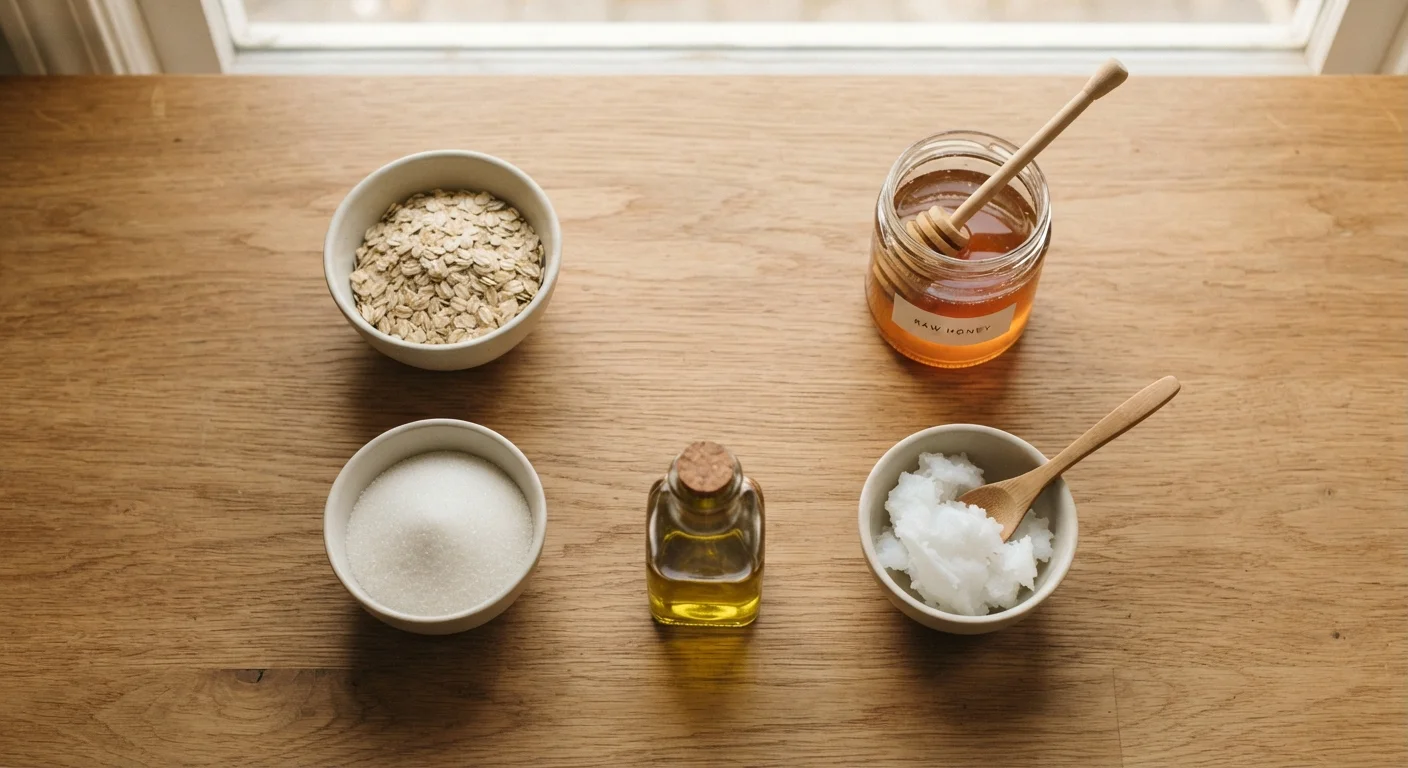
Key Takeaways
What is already in your kitchen
Plenty of households already stock ingredients that people have used for skin and hair care for generations. The appeal is straightforward: lower cost, fewer packaging decisions, and a shorter ingredient list you can actually read. The chemistry behind some of these uses is well-documented. Others rely more on tradition than clinical evidence.
This article covers common pantry items people incorporate into personal care, what the ingredient actually does, and where the evidence is solid versus limited. It is general information, not a substitute for professional skincare advice. If you have a diagnosed skin condition, speak with a dermatologist before changing your routine. See how to build a simple skincare routine for a broader starting framework.
Always patch test before applying anything new
Apply a small amount of any new ingredient to the inside of your wrist or behind your ear. Wait at least 24 hours and look for redness, itching, swelling, or any other reaction before using it on a larger area. Food allergies can cause skin reactions, so factor in any known sensitivities before trying a new pantry ingredient on your skin.
These uses apply to generally healthy skin. Conditions such as eczema, rosacea, acne, or psoriasis may react unpredictably to food-based ingredients. A dermatologist's guidance is the right starting point for those situations.
Pantry ingredients with personal care applications
Colloidal oats
Finely ground oats, often called colloidal oats when milled to a very fine powder, have well-established skin-calming properties. The U.S. Food and Drug Administration has recognized colloidal oatmeal as a skin protectant ingredient. Oats contain avenanthramides, compounds with anti-inflammatory properties, along with beta-glucan, which forms a light barrier on the skin surface and supports moisture retention.
A simple use is adding plain, unflavored rolled oats ground in a blender to lukewarm bathwater. This has a long history of use for general skin comfort. As a paste applied to the face and rinsed off, ground oats act as a gentle physical exfoliant. The evidence here is stronger than for many other kitchen-cabinet options because the FDA classification reflects actual clinical review. Flavored or instant oats with added sugars and artificial ingredients are not appropriate substitutes.
The FDA has recognized colloidal oatmeal as a skin protectant, which separates it from most kitchen-cabinet options.
Raw honey
Honey is hygroscopic, meaning it draws moisture from the air, which is why it has been used as a humectant in skin preparations. It also has antimicrobial properties related to its low water activity and the presence of hydrogen peroxide generated by the enzyme glucose oxidase. Manuka honey has received more clinical attention than standard grocery store varieties, but the basic chemistry applies broadly to raw honey.
People use honey as a rinse-off face mask, applied thinly for 10 to 15 minutes and rinsed with warm water. It is not appropriate for open wounds or broken skin without medical guidance. Those with pollen allergies should use caution, and anyone who reacts to bee products should avoid it entirely. The stickiness makes it less practical as a leave-on product.
Honey draws moisture from the air, which is the same mechanism behind many commercial humectant serums.
Coconut oil
Coconut oil is high in lauric acid, a medium-chain fatty acid that laboratory studies have shown can penetrate the hair shaft more effectively than mineral oil or sunflower oil. This is the basis for its use as a pre-wash hair treatment: applying it before shampooing may reduce protein loss from the hair strand during washing. For skin, it is an occlusive, meaning it slows water loss from the surface rather than adding moisture to it.
The limitation worth knowing: coconut oil rates high on the comedogenic scale for some skin types, meaning it may block pores and contribute to breakouts in acne-prone individuals. It works better as a body moisturizer or heel treatment than as a face product for many people. It is also a reasonable makeup brush conditioner and a common ingredient in DIY lip balm. Smart substitutions like this can add up to real savings over time.
Coconut oil penetrates the hair shaft more effectively than many other oils, making it useful as a pre-wash treatment.
Sugar
Granulated sugar dissolves readily in water and on skin contact, which makes it a gentler physical exfoliant than salt for most people. The particle size and shape are less likely to cause micro-tears in skin compared to coarser abrasives. Sugar also contains trace amounts of glycolic acid, an alpha hydroxy acid (AHA) that appears in many commercial exfoliating products, though the concentration in raw sugar is far lower than in formulated skincare.
A basic use is combining sugar with a carrier oil such as olive oil or jojoba oil to make a rinse-off body scrub. This is not appropriate for the face for many people because facial skin is thinner and more reactive than body skin. Physical exfoliation of any kind should be skipped over active breakouts, sunburned skin, or any area with cuts or irritation.
Sugar dissolves on contact with skin, which limits the abrasion risk that makes coarser scrubs problematic.
Olive oil
Olive oil has been used in personal care for centuries, and it contains squalene (a compound also produced naturally by human sebaceous glands), as well as oleic acid and vitamin E. As an occlusive and emollient, it softens and seals moisture into skin. It has a long record of use as a cuticle treatment, a body oil, and a hair conditioning rinse applied before washing.
Research on olive oil applied directly to skin is mixed. Some studies suggest the high oleic acid content may disrupt the skin barrier in eczema-prone individuals, so it is not universally suitable for sensitive or compromised skin. For general body use on normal to dry skin, it is a functional option at a fraction of the cost of specialty body oils. Simple, low-cost habits across health and personal care can accumulate meaningful savings without requiring major lifestyle changes.
Olive oil contains squalene, a compound the body produces naturally, which partly explains its long history as a skin treatment.
Apple cider vinegar
Apple cider vinegar (ACV) has a pH around 2 to 3, which is considerably more acidic than healthy skin's natural pH of around 4.5 to 5.5. Proponents suggest that diluted ACV, used as a toner or scalp rinse, may help balance the skin's acid mantle. The acid mantle is the thin protective film on skin's surface that helps resist bacteria and environmental damage.
The evidence for ACV in skincare is largely anecdotal, and applying it undiluted risks chemical burns. Dilution is essential: a common ratio used is one part ACV to several parts water, though individual skin tolerance varies considerably. ACV is not appropriate on the face for anyone with sensitive skin, active acne lesions, or a compromised skin barrier. A dermatologist's input is worth seeking before incorporating it into any regular routine.
ACV must always be diluted before skin contact; applying it undiluted can cause chemical burns.
Using these ingredients sensibly
Patch testing is non-negotiable. Apply a small amount to the inside of your wrist or behind your ear, wait 24 hours, and check for redness, itching, or irritation before using the ingredient on a larger area. Food allergies can translate into skin reactions, so anyone with a nut allergy, for example, should avoid almond or coconut-based applications without clearing it with a healthcare provider first.
Storage also matters. Oils can go rancid, honey can crystallize and harbor contamination if water is introduced, and oat preparations should be made fresh. Food-grade ingredients are not always manufactured to the same purity standards as cosmetic-grade versions, which is worth knowing if you use them regularly. A routine audit checklist can help you track what is working and what to cut. For hair-specific applications, an honest look at DIY hair masks sets realistic expectations about what kitchen recipes can accomplish.
This article is for general informational purposes only and is not medical or dermatological advice. Consult a qualified healthcare professional before making changes to your skincare routine, particularly if you have a skin condition or known allergies.