

Key Takeaways
Low cost per application
Most effective DIY mask ingredients cost under a dollar per use, compared to several dollars for commercial deep conditioners. Savings add up meaningfully over months of regular use.
Genuine short-term moisture boost
Humectant ingredients like honey and emollient oils like olive or avocado demonstrably increase hair's moisture level and smoothness for a day or two after application.
No synthetic preservatives or fragrance
People with sensitivities to common cosmetic additives may tolerate simple food-based masks better than commercial products, as long as they are not allergic to the food itself.
Immediate availability
Ingredients are already in most kitchens, so there is no need to shop, wait for delivery, or keep a separate inventory of beauty products.
Cannot repair structural hair damage
Food-based proteins have molecular weights too large to penetrate the hair cortex. Bleach damage, heat fractures, and chemical breakage require professionally formulated bond-builders or reconstructors.
Results are temporary and variable
Benefits wash out with the next shampoo. Outcomes vary significantly by hair type, porosity, and water quality, making it hard to replicate consistent results.
Some ingredients cause irritation or buildup
Acidic additives, spices, and heavy oils like coconut oil can irritate the scalp or cause protein buildup in certain hair types, potentially increasing brittleness over time.
No pH control or preservation
Homemade masks are not pH-balanced for hair (ideally 4.5 to 5.5) and have no shelf life. Using an expired or incorrectly acidic mixture can do more harm than good.
Time-intensive preparation and cleanup
Mixing, application, processing time, and washing out oily or sticky ingredients takes significantly longer than applying a store-bought conditioner.
Our Verdict
DIY hair masks are a legitimate, low-cost option for adding moisture and a temporary smoothness boost to hair that is generally healthy but dry or dull. Their benefits are cosmetic and short-lived, not structural. Anyone dealing with chronic breakage, scalp conditions, or chemically processed hair should set careful expectations and consult a professional when problems persist.
Families looking to stretch their beauty budget who want a low-risk way to supplement regular conditioning for normal to dry hair types.
What DIY hair masks actually do
Kitchen-based hair masks work primarily as occlusive or humectant treatments. Oils like olive and coconut form a barrier on the hair shaft that slows moisture loss. Honey draws water to the hair from its surroundings. Avocado and egg yolk deposit fatty acids and lipids that temporarily fill gaps in the cuticle layer, making hair feel smoother and look shinier.
These effects are real, but they are surface-level. The hair shaft is not living tissue. Ingredients cannot permanently bond to it the way a professionally formulated treatment can. After washing, most of the benefit is gone. Think of a DIY mask less like a treatment and more like a conditioning session with extra intensity.
For more context on how common pantry items work in personal care, see how pantry ingredients translate to personal care.
Low cost per application
Most effective DIY mask ingredients cost under a dollar per use, compared to several dollars for commercial deep conditioners. Savings add up meaningfully over months of regular use.
Genuine short-term moisture boost
Humectant ingredients like honey and emollient oils like olive or avocado demonstrably increase hair's moisture level and smoothness for a day or two after application.
No synthetic preservatives or fragrance
People with sensitivities to common cosmetic additives may tolerate simple food-based masks better than commercial products, as long as they are not allergic to the food itself.
Immediate availability
Ingredients are already in most kitchens, so there is no need to shop, wait for delivery, or keep a separate inventory of beauty products.
Where kitchen masks fall short
Hair that has been bleached, repeatedly heat-styled, or chemically relaxed has structural damage at the cortex level. The proteins that give hair its tensile strength are broken or missing. No kitchen ingredient reliably rebuilds that structure. Eggs contain protein, but the molecular weight of food-grade proteins is generally too large to penetrate the cuticle and reach the cortex where repair would need to happen.
Porosity is another limit. High-porosity hair (which has a lifted cuticle) loses moisture fast regardless of what is applied. A yogurt or banana mask might make it feel softer for a day, but the underlying porosity remains. Addressing that usually requires a professionally formulated reconstructor or bond-building treatment.
Some ingredients also cause problems. Lemon juice and apple cider vinegar are acidic and, used too frequently or undiluted, can weaken hair further or irritate the scalp. Cinnamon and other spice-based recipes popular online have caused documented scalp irritation in some users. Coconut oil, widely praised, can cause protein buildup and increased brittleness in certain low-porosity hair types.
Cannot repair structural hair damage
Food-based proteins have molecular weights too large to penetrate the hair cortex. Bleach damage, heat fractures, and chemical breakage require professionally formulated bond-builders or reconstructors.
Results are temporary and variable
Benefits wash out with the next shampoo. Outcomes vary significantly by hair type, porosity, and water quality, making it hard to replicate consistent results.
Some ingredients cause irritation or buildup
Acidic additives, spices, and heavy oils like coconut oil can irritate the scalp or cause protein buildup in certain hair types, potentially increasing brittleness over time.
No pH control or preservation
Homemade masks are not pH-balanced for hair (ideally 4.5 to 5.5) and have no shelf life. Using an expired or incorrectly acidic mixture can do more harm than good.
Time-intensive preparation and cleanup
Mixing, application, processing time, and washing out oily or sticky ingredients takes significantly longer than applying a store-bought conditioner.
Cost and convenience in context
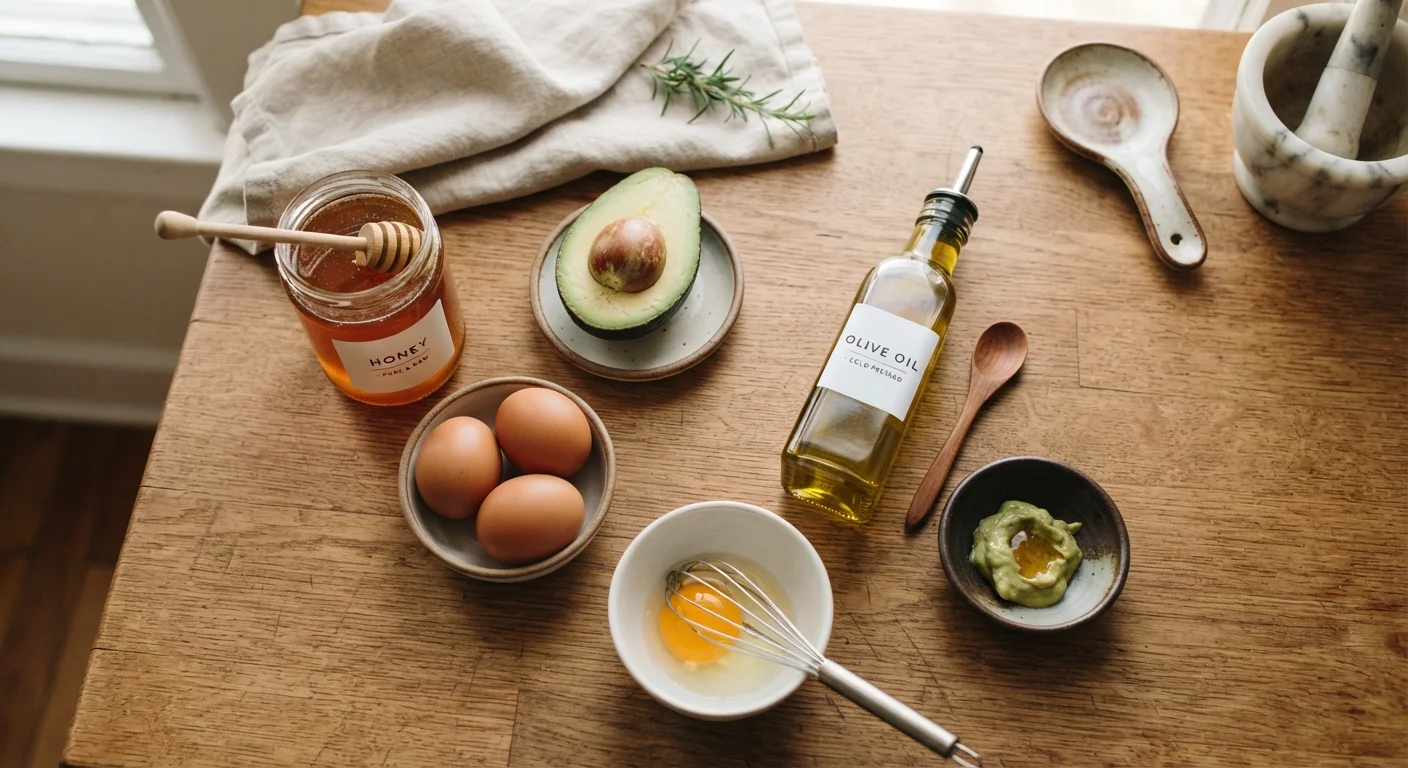
The financial argument for DIY masks is straightforward. A tablespoon of honey, half an avocado, and a teaspoon of olive oil cost well under a dollar per application. Comparable commercial deep-conditioning treatments can run several dollars per packet or considerably more for salon products.
The trade-off is consistency and stability. Commercial formulas are pH-balanced, preserved, and tested for efficacy and safety. A home recipe has none of that. Freshness matters: a mask made with egg left on the hair too long in a warm bathroom is a food safety concern, not just an aesthetic one.
Under $1
Typical cost per DIY mask application
A basic avocado, honey, and olive oil mask uses ingredients costing well under one dollar per session at standard grocery prices.
4.5 to 5.5
Optimal pH range for hair and scalp
Hair care chemists generally cite this range as healthy for the cuticle; most kitchen masks are not formulated or tested to hit it.
Time is also a real cost. Mixing, applying, sitting with the treatment, and cleanup can add 30 to 60 minutes to a routine. For families with tight schedules, that calculation is worth making honestly. The savings are genuine, but they come with a time investment that a drugstore conditioner does not require.
For a broader look at where beauty spending adds little actual value, see which beauty purchases rarely justify the cost.
When to stop DIYing and get help
Persistent scalp flaking, itching, or hair loss are not situations where a kitchen mask is appropriate. Those symptoms can indicate seborrheic dermatitis, psoriasis, alopecia, or other conditions that need a dermatologist's assessment. Applying food ingredients to an already irritated scalp can make inflammation worse.
Significant breakage that does not improve after several weeks of consistent gentle care, a balanced diet, and adequate hydration also warrants professional input. A licensed cosmetologist or trichologist can assess whether the cause is mechanical (too much heat or tension), chemical, or health-related, and recommend targeted treatment.
When hair loss or scalp symptoms appear
Noticeable hair shedding beyond normal daily loss (roughly 50 to 100 strands per day is considered typical), persistent scalp pain, or visible patches are medical symptoms, not cosmetic ones. A dermatologist or trichologist is the right starting point. General information about hair masks does not apply to these situations, and home treatments should not substitute for professional evaluation.
The same logic that applies to deciding when a home repair is beyond DIY scope applies here: knowing the limits of a self-administered approach saves time, money, and in some cases, further damage. For a framework on how to think about that trade-off in general, the DIY vs. professional decision framework is a useful reference.
This article is for general informational purposes only and is not medical or professional hair care advice. Consult a licensed dermatologist or healthcare provider for any scalp or hair concerns that persist or worsen.