

Key Takeaways
Why the beauty aisle keeps costing more than it should
The average American household spends a meaningful portion of its personal care budget on products that see minimal use after the first week. This is not a discipline problem. It is a predictable outcome of how beauty marketing works: short video content, influencer unboxings, and "limited edition" packaging create urgency that bypasses the simple question of whether the product addresses a real need.
Price and performance do not reliably align in the beauty aisle, and that gap is widest in the categories where visual branding does the heaviest lifting. The mistakes below are where family budgets most often take quiet, repeated hits.
Buying facial toning mists as a separate skincare step.
Why it happens: Mists are photogenic, feel refreshing, and are priced low enough to feel like a low-risk add-on. Social content frames them as a hydration essential.
Purchasing pore-minimizing vacuums or suction devices for blackheads.
Why it happens: The before-and-after videos are persuasive, and pore appearance is a persistent skin concern. Devices feel more "medical" and therefore more effective than a basic cleanser.
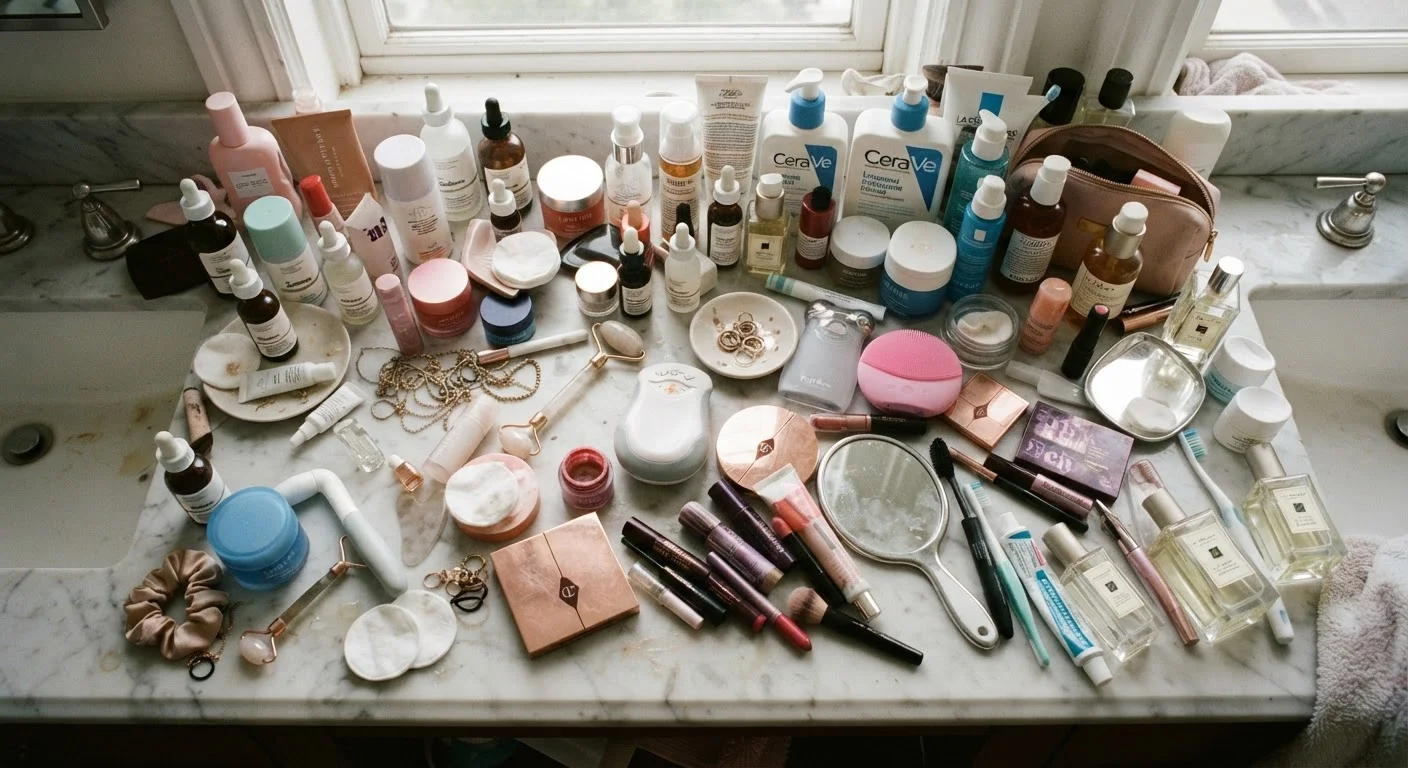
Stocking multiple versions of the same product type.
Why it happens: A new serum launches with a compelling ingredient angle, and it is easy to add it to the routine without removing the existing one. This leads to three moisturizers, two vitamin C serums, and four lip balms in rotation.
Investing in facial rollers or gua sha tools expecting lymphatic or contouring results.
Why it happens: These tools carry wellness connotations and are heavily promoted alongside claims about puffiness reduction and facial lifting. The ritual feel makes them seem like they must be doing something significant.
Buying full-size products after seeing a single positive review.
Why it happens: Positive reviews are highly visible; negative ones take more searching. Influencer content rarely addresses the full range of skin types, and readers assume the experience will transfer.
Treating supplement-based beauty products as equivalent to topical skincare.
Why it happens: "Beauty from within" positioning is effective marketing. Collagen supplements, biotin gummies, and similar products feel holistic and are easy to add to a daily habit.
What to do instead of buying another product
Before any new purchase, it helps to run through what you already own. A monthly routine audit can surface expired items, duplicates, and products bought on impulse that never became habits. Eliminating those first creates a clearer picture of genuine gaps.
When a gap does exist, check the ingredient list before the brand name. Dermatology research consistently points to a short list of well-studied actives: retinoids, vitamin C, niacinamide, sunscreen, and a few others. Most other ingredients are supporting cast at best. Drugstore formulas frequently contain those same actives at a fraction of the cost.
For hair care, homemade masks from pantry staples can address moisture and manageability without adding another bottle to the bathroom. They have real limits, but for routine conditioning they hold up. Getting more from products you already own, through correct application amounts and technique, often matters more than the products themselves.
Beauty spending shares a pattern with other household categories. Grocery budgets erode the same way: small, recurring purchases that feel insignificant individually but compound into a real monthly total. Treating beauty the way a careful grocery shopper treats the cart, with a list and a reason for each item, is a practical corrective.
~$300
Average annual spend on unused beauty products
Consumer research conducted by various market analysts suggests the average adult in the U.S. discards a meaningful portion of purchased beauty products before using them fully, with estimates commonly cited around $300 per year, though figures vary by source.
5 to 7
Evidence-backed topical actives for most skin concerns
Dermatology literature consistently identifies a small set of well-studied topical ingredients, including retinoids, sunscreen, vitamin C, niacinamide, and AHA/BHA exfoliants, as covering the majority of common skin concerns.