

Key Takeaways
Option A
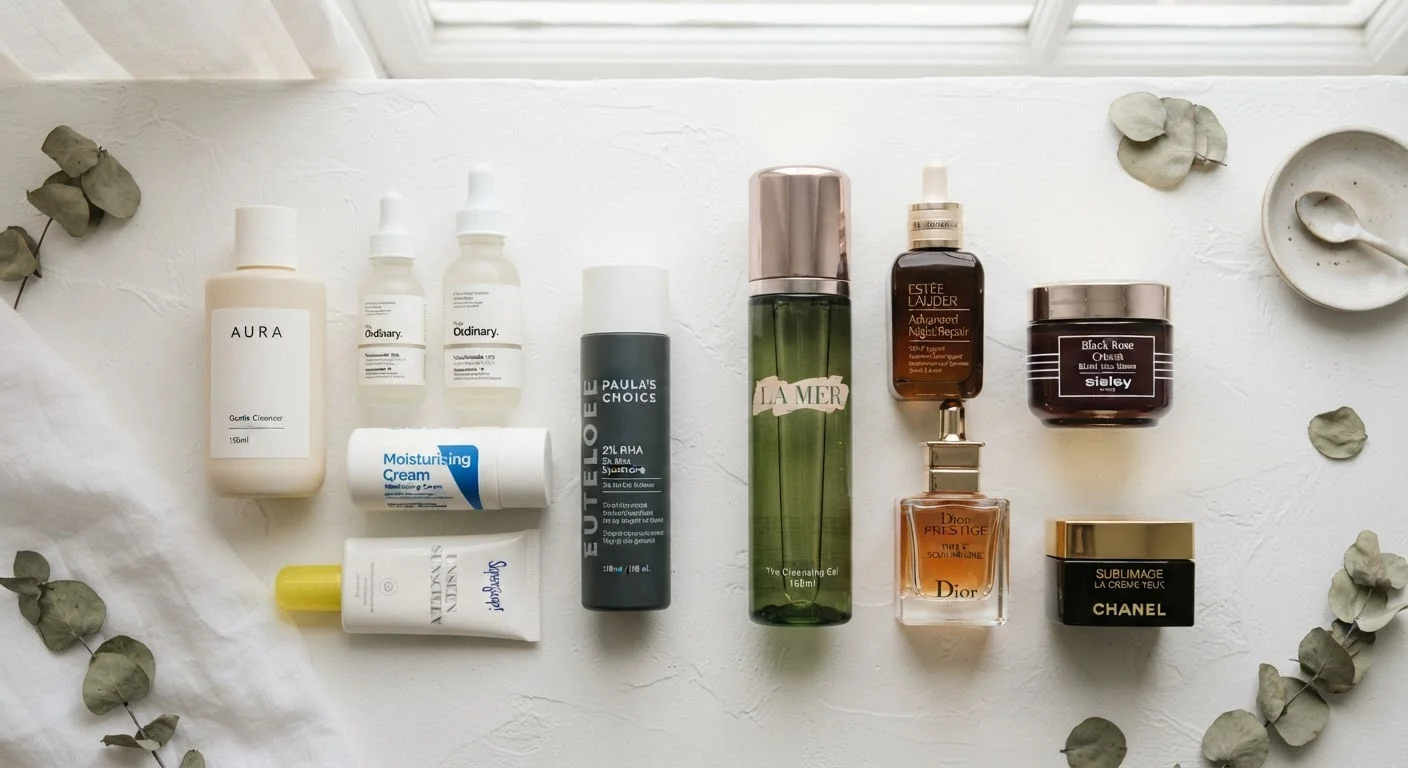
Drugstore skincare
The accessible, ingredient-driven option available at mass retailers.
Best for: Shoppers who want clinically recognized ingredients without a high price tag.
Option B
Department store skincare
The premium, experience-focused category sold at counters and specialty retailers.
Best for: Those who want tailored service, exclusive textures, or formulations with proprietary complexes.
If your priority is proven actives at the lowest cost
Drugstore skincare
Well-established actives like retinol, salicylic acid, and glycolic acid appear in many drugstore formulas at concentrations dermatologists commonly discuss as effective.
If texture, scent, or application experience matters as much as results
Department store skincare
Luxury lines often invest more in sensory formulation, which can improve consistency of use, though this does not automatically mean better skin outcomes.
If you have a specific, diagnosed skin condition
Neither - consult a dermatologist first
Neither category reliably addresses conditions like rosacea or cystic acne without professional guidance. A dermatologist can recommend prescription or over-the-counter options matched to your skin.
If you want to stretch your household beauty budget
Drugstore skincare
For most foundational steps such as cleanser, moisturizer, and SPF, the ingredient overlap with department store options is large enough that switching saves money without a meaningful trade-off.
What you are actually paying for
When a moisturizer at a department store counter costs six times more than one at a drugstore, the formula is not necessarily six times more potent. Pricing in the beauty industry reflects a bundle of costs: raw ingredients, yes, but also packaging, in-store labor, advertising, and brand positioning. The ingredient list is where the actual formula lives, and that list is publicly available on every product sold in the United States under FDA labeling rules.
Ingredients are listed in descending order by concentration. A hydrating serum that leads with water, glycerin, and hyaluronic acid has the same fundamental architecture whether it costs $12 or $120. The differences that do exist tend to fall into a few specific categories: proprietary delivery systems, fragrance complexity, patent-protected molecules, and the feel and finish of the formula. Those differences may matter to some people, but they are worth identifying honestly rather than assuming the price reflects superior performance across the board.
For a broader look at how marketing spend factors into beauty pricing, see why expensive does not always mean effective in beauty products.
| Criterion | Drugstore skincare | Department store skincare |
|---|---|---|
| Average price range | $5 to $25 per item | $40 to $200+ per item |
| Active ingredient availability | Most common actives present | More proprietary complexes |
| SPF efficacy standards | Same FDA OTC standards | Same FDA OTC standards |
| Fragrance in formula | Often fragrance-free options | More frequent use of fragrance |
| Texture and sensory experience | Functional, variable | More consistent refinement |
| R&D and delivery technology | Less common | More common in premium lines |
| In-store guidance | Self-service | Counter consultations available |
Where the gap is real and where it is not
There are categories where higher-priced products have a genuine formulation edge. Encapsulated retinol, time-release vitamin C derivatives, and peptide complexes are more common in premium lines partly because the raw materials cost more and partly because the brands investing in them tend to have larger R&D budgets. These delivery technologies can improve stability and reduce irritation, which matters for sensitive skin types.
On the other hand, workhorse ingredients like niacinamide, benzoyl peroxide, alpha hydroxy acids, and broad-spectrum SPF filters do not require luxury packaging to work. The FDA regulates sunscreen as an over-the-counter drug, meaning a drugstore SPF 30 must meet the same safety and efficacy standards as a department store one at four times the price. The same logic applies to acne treatments: salicylic acid is salicylic acid regardless of the counter it comes from.
Texture and sensory experience are worth acknowledging. If a product feels unpleasant, many people stop using it, which negates any formula benefit. Department store lines often invest more in this dimension, and for some consumers that translates into genuine consistency of use. That is a real value, though a personal one.
For guidance on building a routine around these realities, a simple skincare routine guide covers the foundational steps without unnecessary complexity.
How to read the label instead of the price tag
Comparing products by ingredient list takes about two minutes and tells you more than the packaging ever will. Look at the first five ingredients: those make up the majority of the formula by weight. Then check whether the actives you are targeting (retinol, niacinamide, an AHA) appear near the top or near the bottom. An ingredient listed after the preservatives is present in a very small amount and unlikely to drive a meaningful result.
Fragrance, listed as "fragrance" or "parfum," is worth noting. It is more common in luxury lines for sensory reasons, but it is also the most frequent cause of contact dermatitis in leave-on products. Some drugstore lines are fragrance-free by default, which is clinically preferable for sensitive or reactive skin.
If a product makes a specific claim, such as "clinically proven to reduce wrinkles," look for the study methodology. Many such studies are small, short-term, and funded by the brand itself. That does not make the product ineffective, but it does mean the claim deserves scrutiny rather than deference.
This article is general information about skincare formulation. It is not medical or dermatological advice. Consult a licensed dermatologist for concerns specific to your skin type, condition, or any reactions you experience.
For more on where beauty spending tends to miss its mark, see beauty products you probably do not need and how to stretch your beauty budget for practical ways to make what you already own go further.
This article is for general informational purposes only and does not constitute medical or dermatological advice. Consult a qualified healthcare professional for guidance on your specific skin concerns.