

Key Takeaways
Start here
What these sources actually are
Next
What you can realistically find
Then
How to evaluate materials before you buy
Apply it
Practical sourcing strategies
Before you go
Limits and trade-offs to keep in mind
What these sources actually are
Three distinct types of sources sell usable building materials at below-retail prices, and they work differently from one another.
Reuse centers (sometimes called deconstruction stores or building material resellers) accept donated or deconstructed materials and resell them. Habitat for Humanity ReStores are the most widely known U.S. example, but many cities have independent nonprofit or municipal versions.
Surplus outlets carry new or unused materials that contractors, manufacturers, or retailers need to clear. Overstock flooring, discontinued tile, and job-lot lumber commonly appear here. The goods are new; the discount comes from volume or discontinuation, not condition.
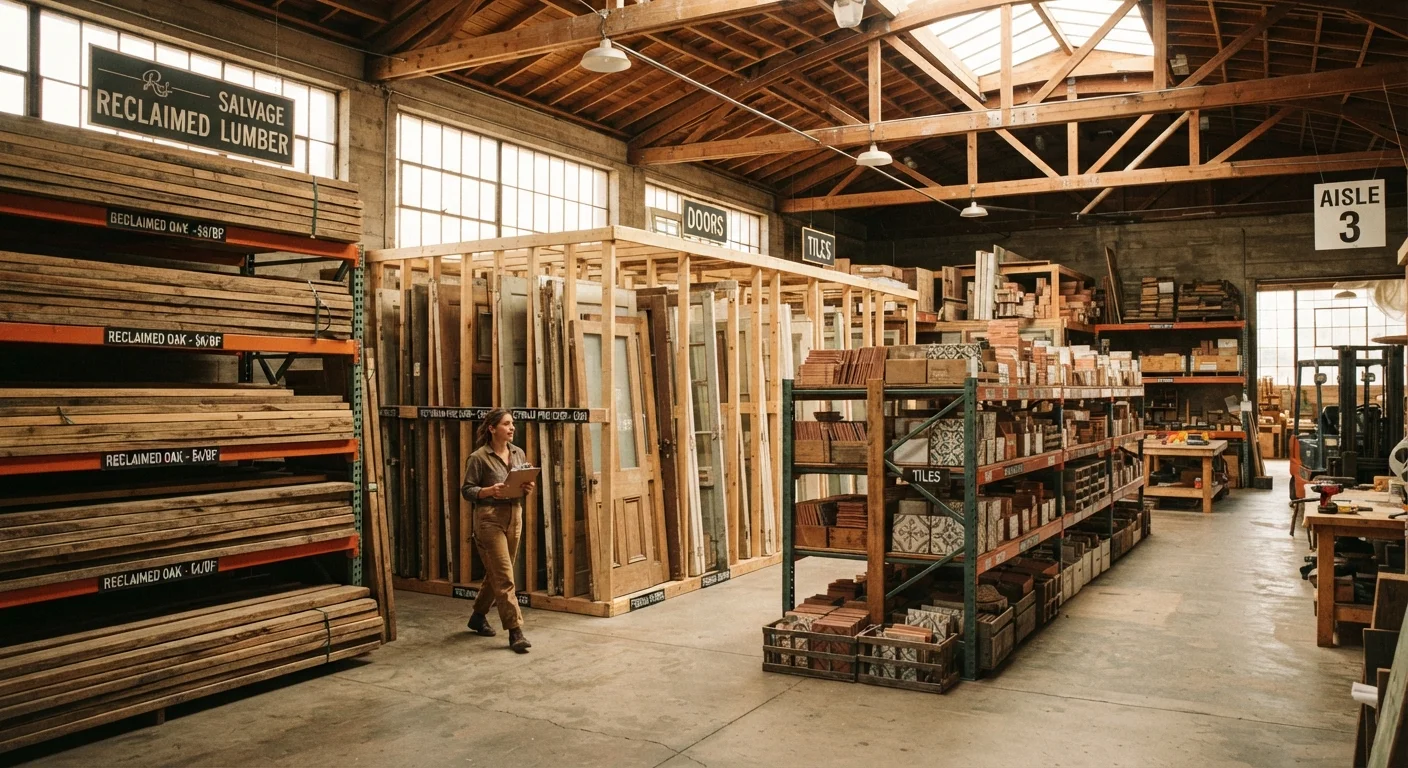
Salvage yards focus on materials pulled from demolition or renovation projects. Structural lumber, doors, windows, fixtures, and architectural elements are typical stock. Quality varies, and inventory changes constantly.
For families working on home projects with limited budgets, these three channels can cover a wide range of needs. A good starting point for broader budget context is the Frugal Family Finance hub, which covers money strategies applicable across household spending.
Reuse center
A store that accepts donated or deconstructed building materials and resells them at reduced prices, often operated by a nonprofit organization.
Surplus materials
New or unused building materials that a contractor, retailer, or manufacturer has in excess and sells at a discount to clear inventory.
Salvage
Materials that have been removed from an existing building, typically during demolition or renovation, and made available for reuse.
Deconstruction
The careful disassembly of a structure to preserve materials for reuse, as opposed to demolition, which destroys most of what it removes.
Rough opening
The framed hole in a wall where a door or window is installed. Knowing this measurement is necessary before buying a salvaged door or window.
Checking
Surface cracks that run along the grain of lumber, caused by drying. Minor checking is often cosmetic, but deep checking can reduce structural strength.
What you can realistically find
Expectations matter. These sources are not predictable like a hardware store: you cannot walk in expecting a specific SKU. What you can find, with some frequency, includes:
- Interior and exterior doors (solid wood doors are common at salvage yards)
- Windows, though you need to verify energy performance and glass condition
- Hardwood flooring, often in shorter lengths that work well for smaller rooms
- Dimensional lumber in common sizes
- Ceramic, porcelain, and stone tile, frequently in surplus quantities from larger projects
- Cabinets and cabinet hardware
- Light fixtures, sinks, and faucets
- Brick, pavers, and concrete block
Items that are harder to source second-hand include insulation (condition is difficult to verify), electrical panels and wiring (code compliance is complex), and materials requiring matched sets in large quantities.
How to evaluate materials before you buy
Buying without inspection is the main way these sources become expensive rather than economical.
Structural materials
Check lumber for warping, checking (surface cracks along the grain), and signs of rot or insect damage. Probe suspicious areas with a screwdriver; soft or crumbling wood is not structurally usable. Look at the cut ends for insect galleries or staining.
Doors and windows
Measure before you go. Bring the rough opening dimensions from your project, and check that salvaged units match or can be trimmed to fit. Inspect for cracked glass, broken hardware, and frame rot at the corners and sill.
Tile and flooring
Count pieces carefully and add at least 10 percent for cuts and breakage. Inspect each piece for chips and cracks. For tile, verify that grout color can be matched if you are extending an existing floor.
Fixtures and hardware
Test anything mechanical. Turn valves, open faucets, check that drains are complete. Missing parts on older fixtures can be difficult to source.
Lead and asbestos
Materials from homes built before 1978 may have lead paint. Older floor tiles, pipe insulation, and some ceiling tiles may contain asbestos. Inexpensive test kits are available for lead; asbestos testing requires a certified professional. Do not sand, cut, or disturb suspect materials without proper identification first.
Practical sourcing strategies
Going in with a plan makes a meaningful difference. Bring:
- A measuring tape and your project dimensions written down
- Photos of the space where materials will be installed
- A list of acceptable material types and a clear quantity minimum
Visit reuse centers more than once. Stock turns over fast, and what was absent last week may be there now. Many stores post new arrivals on social media or maintain email lists; subscribing takes a few minutes and removes the need to guess when to visit.
For surplus outlets, ask staff directly about upcoming clearance lots. Contractors sometimes call ahead to get first access to large shipments.
Online community boards and local buy-nothing groups are also legitimate sourcing channels for smaller quantities of materials, particularly for finishing items like hardware, trim, and light fixtures.
If your project is still in the planning phase, this approach pairs well with a household declutter audit, which helps identify what you already have before spending on anything new.
Bring your measurements every time
The most common sourcing mistake is finding a great piece and then discovering it does not fit. Write your rough opening dimensions, room square footage, and any critical measurements on a card you keep with your phone. Reuse centers move stock quickly, and you often need to decide on the spot.
Limits and trade-offs to keep in mind
Second-hand sourcing works best for flexible projects. If your renovation has a firm deadline and requires consistent quantities of matching material, the unpredictability of salvage and surplus stock is a real constraint, not a minor inconvenience.
Permits and inspections still apply. Using salvaged materials does not exempt a project from local building codes. For structural work, electrical work, gas lines, or roofing, a licensed contractor should be involved regardless of where the materials came from. Verify local permit requirements with your municipal building department before starting any regulated work.
Transportation is a cost that gets overlooked. Salvage yards often do not deliver, and hauling a load of reclaimed lumber or a pallet of tile requires a vehicle, straps, and sometimes help. Factor that into your total project cost estimate.
For projects where the goal is noticeable improvement rather than full renovation, small home upgrades with an outsized impact covers lower-effort options that complement salvage sourcing without requiring large material quantities. And if you are weighing whether to spend less overall or invest in fewer, higher-quality items, the comparison in buying less vs. buying better applies directly to home material decisions.