

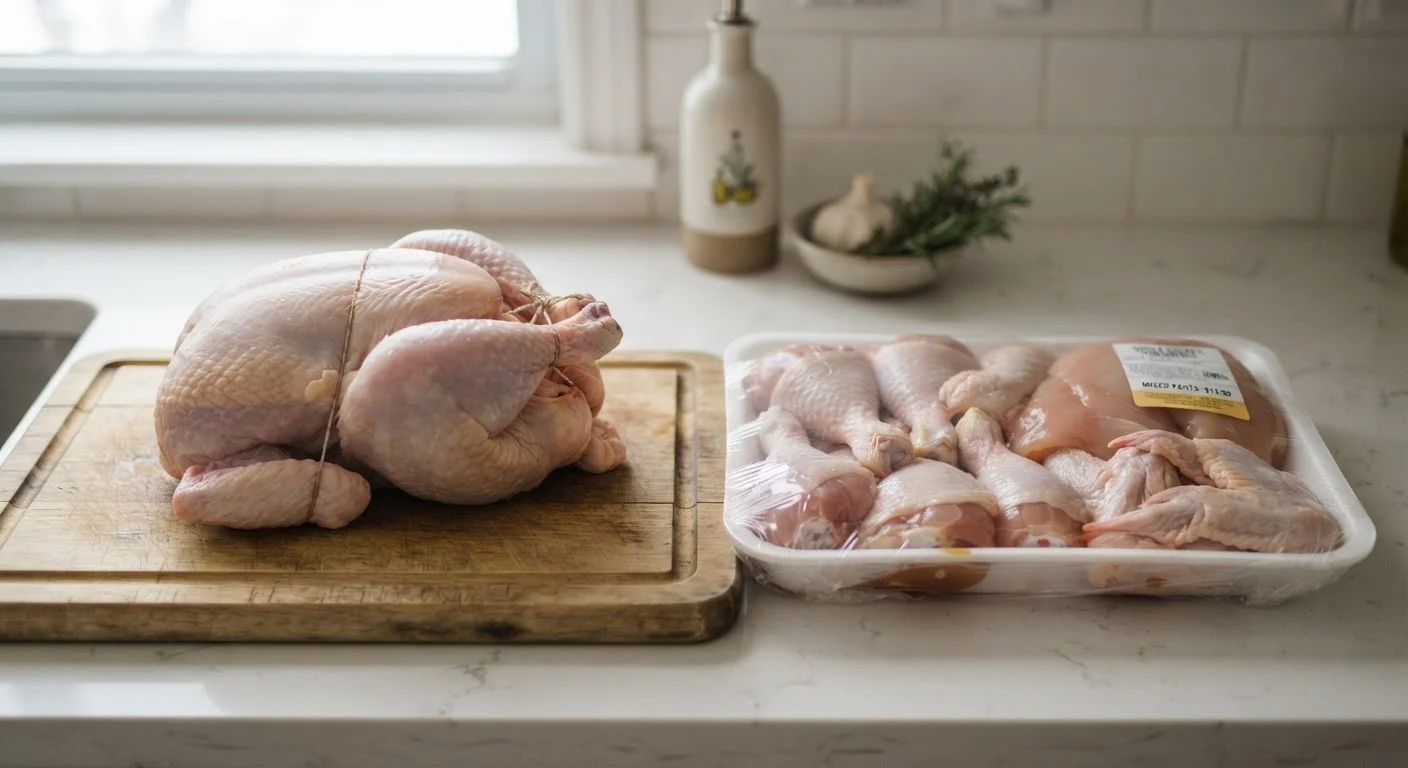
Key Takeaways
Option A
Whole chicken
The lower sticker price that requires more work.
Best for: Families with time to butcher, roast, and use every part including bones for stock.
Option B
Chicken parts
The convenient cut that trades effort for a higher per-pound cost.
Best for: Busy households that want quick weeknight meals without breaking down a whole bird.
If you cook regularly and have 20 minutes to break down a bird
Whole chicken
The per-pound price at most U.S. grocery stores runs noticeably lower than boneless cuts, and the carcass produces stock that adds another meal or two.
If weeknight time is short and you need dinner on the table fast
Chicken parts
Bone-in thighs and drumsticks are usually priced close to whole-bird rates and go straight into a pan or slow cooker with no butchering needed.
If your family will only eat white meat
Chicken parts
Buying a whole bird means paying for legs and thighs your family may not eat, which erases any sticker-price savings.
If you want to reduce food waste and stretch every grocery dollar
Whole chicken
Roast the bird one night, use leftovers in a second meal, then simmer the bones into stock, spreading cost across three separate uses.
What you actually pay per pound of edible meat
The sticker price on a whole chicken looks attractive. In many U.S. stores, a 4- to 5-pound bird runs somewhere around $1.50 to $2.00 per pound, while boneless, skinless chicken breasts can reach $4.00 per pound or higher, depending on the store and region. That gap looks large until you account for what you lose in the butchering process.
A whole chicken yields roughly 65 to 70 percent edible meat after bones, skin (if discarded), and trimmed fat are removed. On a 4-pound bird priced at $1.80 per pound, you pay about $7.20 total and walk away with approximately 2.6 to 2.8 pounds of usable meat. That works out to roughly $2.57 to $2.77 per pound of meat you can actually serve. Bone-in thighs, by comparison, often run $1.80 to $2.50 per pound with a higher meat-to-bone ratio than breasts or wings, making their real cost per edible ounce competitive with the whole bird.
The honest math: a whole chicken is not always cheaper on a per-edible-ounce basis. It depends heavily on which parts are on sale that week. Understanding how grocery costs break down can help you spot when a sale on thighs actually beats the whole-bird price.
| Criterion | Whole chicken | Chicken parts |
|---|---|---|
| Typical price per pound (U.S. average) | $1.50 to $2.00 | $1.80 to $4.50+ depending on cut |
| Edible meat yield | 65 to 70% of total weight | 75 to 95% depending on cut |
| Prep time required | 15 to 20 minutes to break down | Minimal to none |
| Stock potential | Full carcass yields 6 to 8 cups | Bone-in cuts yield some; boneless, none |
| Flexibility for picky eaters | Lower: includes all cuts | Higher: buy only preferred cuts |
| Waste risk | Low if all parts are used | Low when buying to order |
Where the whole bird wins on value
The clearest financial advantage of a whole chicken comes from using every part. After roasting, the carcass, neck, and any scraps go into a pot with water, onion, and a few vegetable trimmings to produce 6 to 8 cups of chicken stock. At store prices for boxed stock (roughly $3.00 to $4.00 for 32 ounces), that is meaningful value pulled from something most people throw away.
Spread across three uses, such as a roast one night, leftovers in tacos or a grain bowl the next day, and stock simmering on the weekend, a single $8.00 bird can support multiple meals. That kind of stretching is harder to replicate when you buy only boneless breasts with no bones to simmer.
Families who cook whole birds regularly also report that dark meat stays moist under almost any cooking method, reducing the likelihood of dried-out leftovers that get tossed. Less food waste is real savings. A structured meal plan built around a Sunday roast and two leftover meals is one of the more reliable ways to lower weekly grocery spending without eating the same thing every night.
When buying parts makes more financial sense
Bone-in thighs and drumsticks are the practical middle ground. They cost close to whole-bird prices per pound, require zero butchering, and cook quickly. For a family of four, four thighs (about 2 pounds) bought at $2.20 per pound is a $4.40 protein base for dinner, and the bones can still be simmered if you want stock.
Buying specific parts also prevents the mismatch problem. If three people in your household prefer white meat and one person will eat dark, buying a whole bird means you end up with more of one than you can use before it spoils. Targeted buying reduces that waste. Spending less versus spending smarter is a real tradeoff in family grocery shopping, and parts buying is sometimes the smarter side of that equation.
Boneless, skinless breasts are the one cut where parts buying rarely wins on price. They carry a significant premium over bone-in options, and their lower fat content makes them easier to overcook and waste. If white meat is a priority, bone-in split breasts tend to offer better value and more forgiving cooking than boneless.
Eating well without overspending often comes down to flexibility: knowing which cuts are on sale, which ones your family will actually eat, and whether you have the time and equipment to make the most of a whole bird.