

Key Takeaways
Why maintenance myths persist
Home maintenance advice passes from neighbor to neighbor, contractor to homeowner, and internet forum to forum, often losing accuracy along the way. Some rules that made sense for older home systems no longer apply to modern equipment. Others were never accurate generalizations to begin with but got repeated enough to feel authoritative. The financial cost of following bad advice is real: U.S. homeowners spend billions annually on repairs, and a meaningful share of those costs trace back to deferred maintenance or misdirected upkeep spending.
The myths below cover the most common and financially consequential misconceptions. For each one, the correction is grounded in how home systems actually function, not in what sounds intuitive. You can also find a broader look at spending decisions that cost families more than they save in our home repair budgeting guide.
Myth
You should change your furnace filter every month, no matter what.
Fact
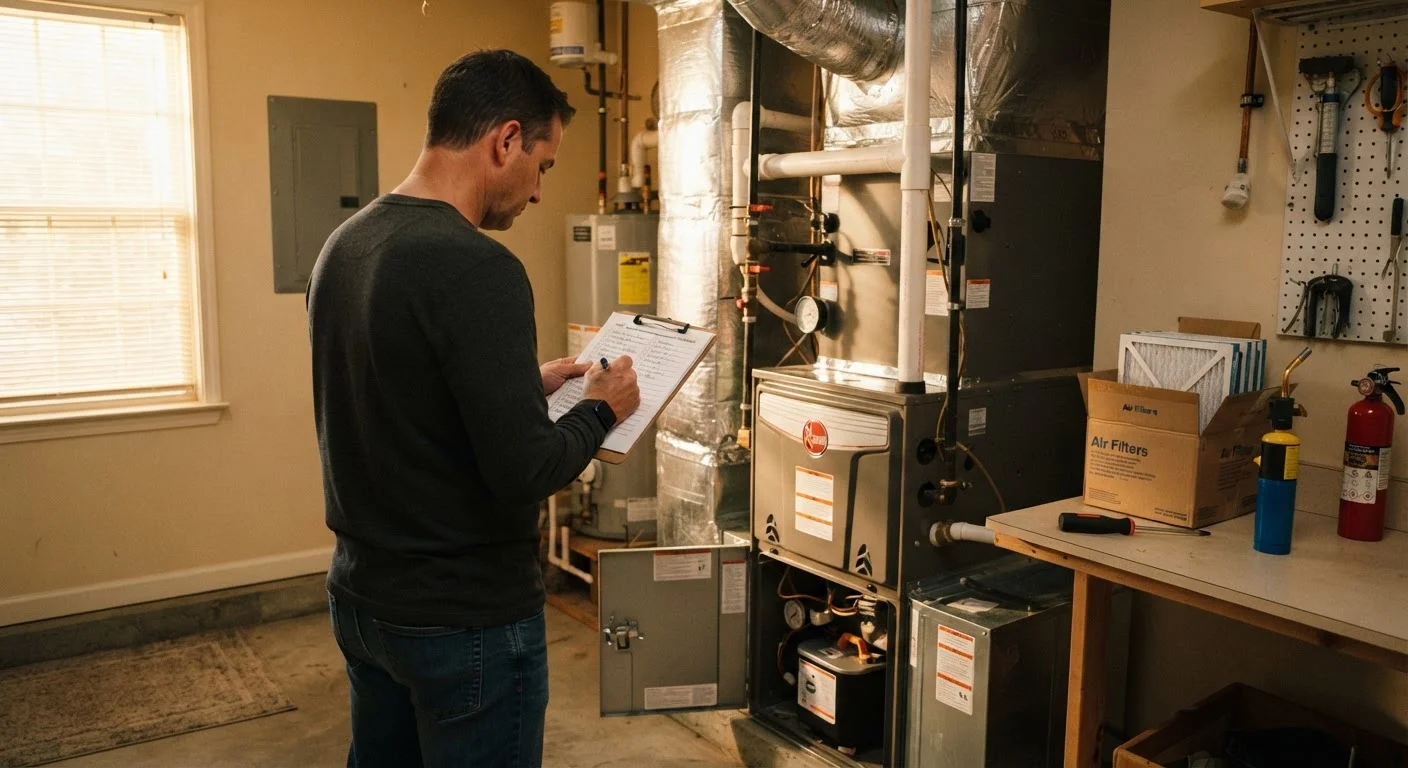
Filter replacement frequency depends on filter type, household size, and whether pets are present. Many filters are rated for 90 days or longer.
The monthly-filter rule is a rough default that does not apply to every home. A basic fiberglass filter in a home with pets and high traffic may genuinely need monthly changes. A thicker pleated filter in a two-person household with no pets can often go 60 to 90 days without any loss of efficiency. Replacing filters earlier than the manufacturer's rating does not improve air quality; it spends money unnecessarily. Check the filter's MERV rating and the manufacturer's recommended interval, then adjust based on your household conditions rather than a fixed calendar schedule.
Myth
If a roof looks fine from the ground, it does not need inspection.
Fact
Many roof problems, including lifted flashing, cracked sealant around penetrations, and early granule loss, are not visible from ground level.
Granule loss on asphalt shingles, which signals the end of a shingle's useful life, typically shows up in gutters before it is visible to the eye from 20 feet below. Flashing failures around chimneys and vents cause interior water damage that can go undetected for months. A periodic close inspection, whether by a licensed roofing contractor or a careful homeowner comfortable on a ladder, catches these issues while repair costs are still modest. Waiting until a leak appears inside the home usually means drywall, insulation, and structural framing are already involved.
Myth
Closing vents in unused rooms lowers your heating and cooling bill.
Fact
Closing vents in a forced-air system increases static pressure and can reduce system efficiency, sometimes causing duct leaks or equipment strain.
Forced-air HVAC systems are designed with a specific balance of supply and return airflow. Closing vents does not redirect conditioned air to other rooms efficiently; it pushes back against the blower, raising pressure in the duct system. Over time this can worsen existing duct leaks or create new ones. The conditioned air still gets produced, just distributed poorly. If certain rooms genuinely do not need conditioning year-round, a licensed HVAC technician can assess whether zoning modifications or variable-speed equipment make sense for the home's layout.
Myth
A small water leak under a sink is not urgent if you put a bucket under it.
Fact
Persistent moisture under a cabinet creates conditions for mold growth and wood rot within days, not months.
Cabinetry under sinks is almost always made from particleboard or MDF (medium-density fiberboard), both of which absorb moisture quickly. A slow drip that fills a bucket over several weeks is simultaneously keeping the cabinet base damp. Mold can begin forming on porous surfaces in as little as 24 to 48 hours under warm, humid conditions. By the time discoloration appears, structural damage to the cabinet and possibly the subfloor below it is already underway. A simple washer or supply-line replacement is a fraction of the cost of cabinet and subfloor remediation. See our guide on when cheap fixes backfire for more examples of delayed costs.
Myth
You only need to clean gutters once a year, in the fall.
Fact
Gutters may need cleaning twice a year, or more, depending on nearby tree coverage and regional rainfall patterns.
Fall cleaning before winter is logical because decomposing leaves are the main culprit. However, spring cleaning removes seedpods, pollen buildup, and debris that accumulated over winter, preventing standing water during spring rains. Homes with pine trees overhead face a third problem: pine needles fall year-round and compact into mats that block downspouts quickly. Clogged gutters drive water back under roofing material and against fascia boards, eventually causing rot and foundation drainage problems. The cost of two gutter cleanings per year is consistently lower than the repair bill for a rotted fascia or a wet basement.
Where these myths hit the budget hardest
Filter over-replacement and unnecessary annual service contracts are relatively low-cost mistakes. The myths around water leaks, roofing, and gutter neglect carry the potential for four- and five-figure repair bills. Mold remediation alone can run from $1,000 to over $10,000 depending on the affected area, according to figures commonly cited by restoration contractors, though actual costs vary widely by region and scope.
The pattern across most of these myths is the same: a small, cheap fix gets skipped or a system gets mismanaged because of a misunderstood rule, and the resulting damage is exponentially more expensive. Our guide to impactful small upgrades covers low-cost actions that genuinely move the needle on comfort and utility costs, without the guesswork.
~35%
Of home energy lost through air leaks
The U.S. Department of Energy estimates that air leaks account for roughly 25 to 40 percent of the energy used for heating and cooling in a typical home.
2x
Cost multiplier for deferred small repairs
Home repair professionals consistently report that minor issues left unaddressed for one season often cost twice as much or more to fix once secondary damage sets in.
24-48 hrs
Time for mold growth to begin on wet surfaces
The EPA notes that mold can begin to grow on damp building materials within 24 to 48 hours under favorable temperature and humidity conditions.
When a repair moves into licensed-trade territory, such as HVAC system modifications, structural concerns, or anything involving electrical panels, the math on DIY shifts considerably. The DIY versus hiring a pro framework lays out a practical way to make that call before picking up a tool.